


















Astronauts have a name for it: the overview effect. The profound sense of clarity when they see Earth from above. The planet stops feeling endless and starts feeling fragile, shared, and worth protecting.
The Dorothy Project, a nonprofit focused on environmental storytelling, makes immersive VR films to bring a version of that feeling to people on the ground. If you’re new to their work, check out our interview with their founder, Mathieu Baptista.
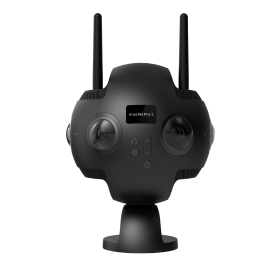
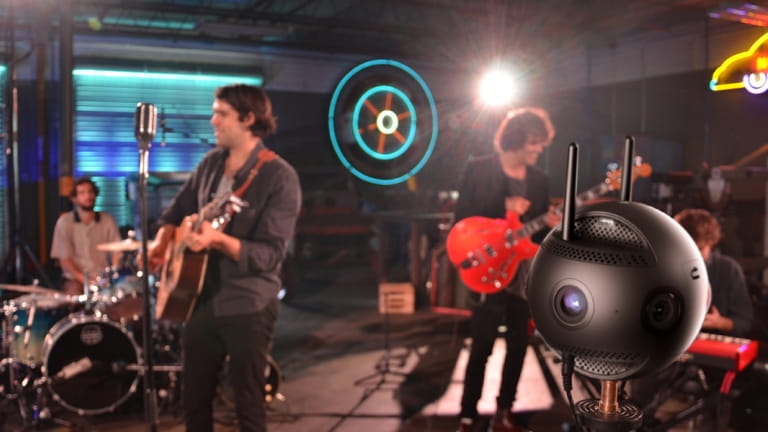
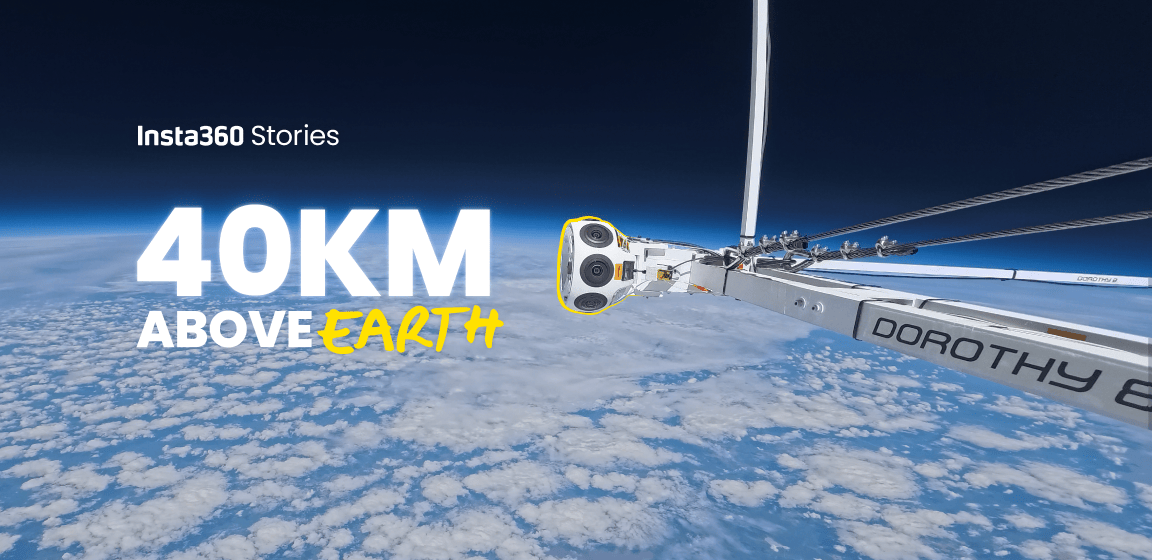
In August 2025, with support from the Canadian Space Agency’s STRATOS program, Team Dorothy built and launched a scientific gondola to nearly 40km above Earth. Alongside research payloads was a world-first: an Insta360 Titan mounted outside the gondola to capture high-resolution stereoscopic 3D 360 footage from near space.
This wasn't Titan "along for the ride". It was Titan as part of the mission.
Why Titan, and why it wasn't simple
Team Dorothy wasn't after a standard postcard shot. In VR, viewers can look anywhere, and if the image isn't clean or the depth doesn't feel real, the illusion breaks. That's why they chose Titan. They wanted the highest possible image quality from the stratosphere to create a true-to-life experience.
Of course, near space doesn't care what a camera is designed for. The atmosphere is dramatically thinner, so heat doesn't dissipate as it normally would. One side of the gondola can bake in direct sunlight at +70°C (158°F) while the other drops to -60°C (-76°F).
The flight would last around 14 hours, which meant lighting would shift constantly. Any camera they sent up had to stay stable, be adjustable from the ground, and have a way back from failure.
Building a system that could survive the stratosphere
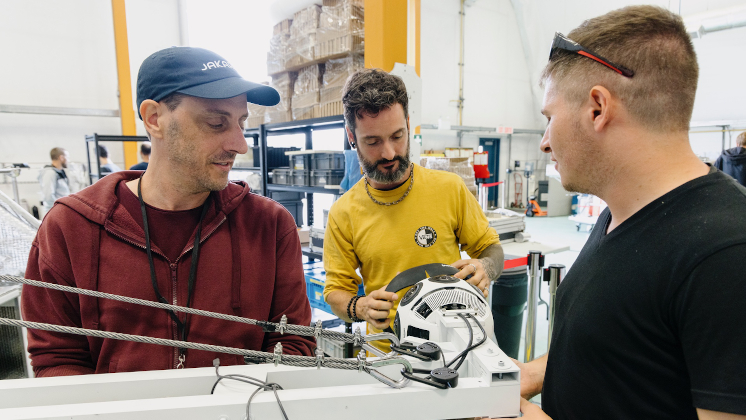
Most equipment was placed inside the aluminum gondola, protected from the worst of the environment. However, Dorothy needed a clear view of Earth, so Titan had to be mounted outside, and that meant months of work.
Over an eight-month build, Team Dorothy developed Dorothy v8, their most robust module yet, and worked with Insta360 to integrate Titan into a monitored, controllable payload system. It had to stay stable through extreme thermal swings, allow remote adjustments during the long flight, and include a reboot path in case the camera stopped responding.
Titan was even repainted with a space-grade thermal coating, similar to what's used on the International Space Station, to reduce solar heating and improve heat loss.
Launch day, and the moment it nearly failed
At the launch base, Dorothy v8 was integrated onto the Space Agency's gondola alongside other scientific experiments and put through end-to-end tests. Then the balloon was filled with more than 2,000 cubic meters of helium. In flight, it would expand to roughly 70 meters wide, about the size of the Statue of Liberty, with a membrane three times thinner than a human hair.
During ascent, everything looked perfect. Titan sent back the first live image, and for the first time the agency and other scientists had a 360 live view from the gondola. After eight months of work, it finally felt like they were watching the mission they'd built.
Then, at around 32km, they lost contact with Titan, before the gondola reached its target altitude of nearly 40km. If Titan stayed offline, they wouldn't just lose a few minutes of footage. They would lose the core footage the entire mission was built to capture.
They tried every option they had from the ground. Forty minutes passed with silence, and eventually they were left with the emergency plan: cut power and attempt a reboot using the push-button mechanism they'd built for this exact scenario. If it didn't work, there was no second attempt and no way to turn it back on.
They pressed the button. Several agonizing seconds later, a signal came through. Titan was back online, and the mood at launch HQ flipped instantly. The mission was still on!
Next problem: bring it home
Now it was about recovery: descent, landing, then locating and retrieving the payload in the remote Canadian backcountry.
In terrain like that, recovery isn't a formality. The retrieval team still had to find the gondola and bring it back, with the raw footage onboard. Once they did, Team Dorothy finally had what they'd spent months building toward: near-space stereoscopic 3D 360 footage, ready for post-production.
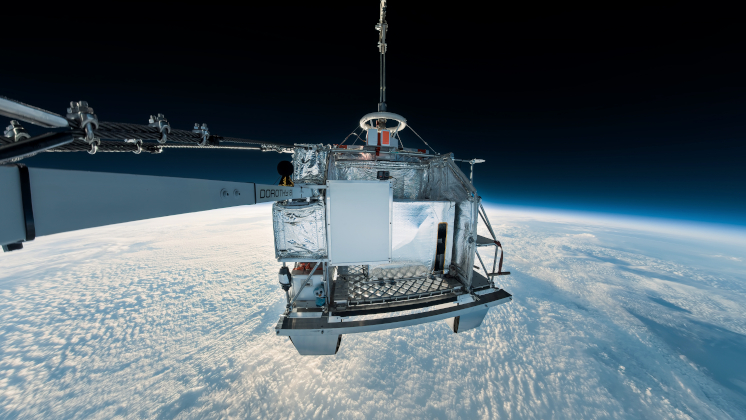
What this world-first means
The Dorothy Project says the footage serves two purposes: contributing to scientific research, and creating an immersive sci-fi film based on real stratospheric imagery, built to inspire and encourage the next generation to explore.
For Insta360, STRATOS is a real source of pride. It helped bring an ambitious project to life, and it showed what Titan can do when conditions are at their harshest. The mission demanded the highest image quality possible from near space, and Titan delivered.
Keen to keep up to date on Insta360 stories? Keep an eye on our blog and sign up for our mailing list. Got a story to share? Email yours to communitystories@insta360.com and win up to US$50.




%20(1).svg)


%20(1).svg)

.svg)