
















For years, turning a real-world space into a 3D model meant specialized cameras, laser scanners, photogrammetry software, and a steep learning curve. Project ETERNAL set out to test a different premise: what if the same pipeline could work with an 8K 360 drone or a pocket-sized camera, a cloud-based 3DGS platform, and a creator who had never tried 3D reconstruction before?
The experiment ran from April to July 2026. More than 2,000 creators across 20 countries participated. The results suggest that spatial content creation is undergoing a fundamental shift. The technology itself is not new. What changed is the workflow: it finally became easy enough for anyone to use.
The Proof of Concept: Pompeii and the Dying City
Before opening the challenge to the global community, the campaign needed to validate the workflow at the highest level. In partnership with CyArk, the world's leading cultural heritage preservation NGO, we selected two of the world's most urgent heritage sites as the benchmark.
Pompeii, the ancient Roman city buried by Vesuvius in 79 AD. Its scale and complexity make it one of the most challenging heritage digitization projects on earth. Civita di Bagnoregio, listed by UNESCO among the world's 100 most endangered sites, is literally eroding. If the A1 and 3DGS workflow could handle these, it could handle anything.
On April 23, the 3DGS models, a short documentary, and companion guided tour pages launched simultaneously on the Antigravity, Insta360, and CyArk websites. The release validated the pipeline at the highest tier of heritage significance and set the stage for what followed.
How the 360-to-3D Workflow Actually Works
The pipeline that powered Project ETERNAL combines three elements that already existed independently.
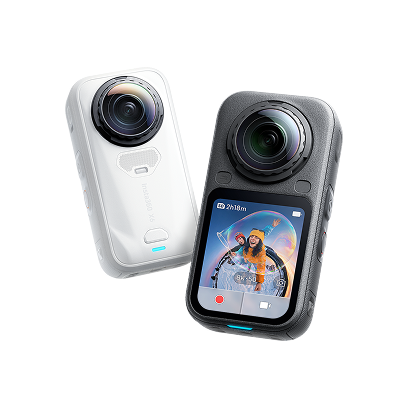
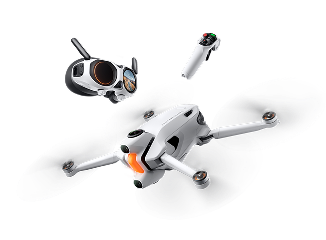
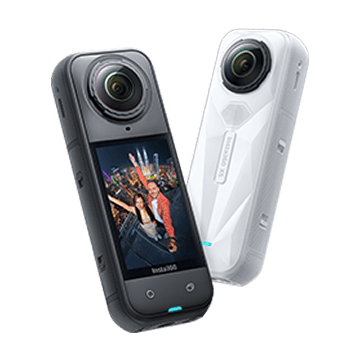
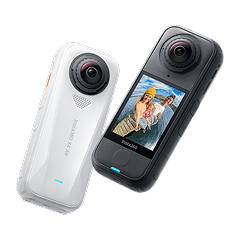
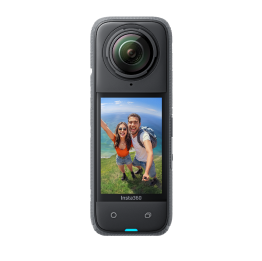
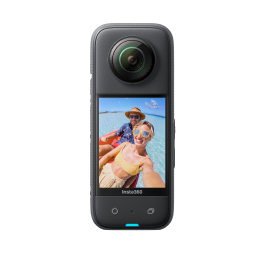
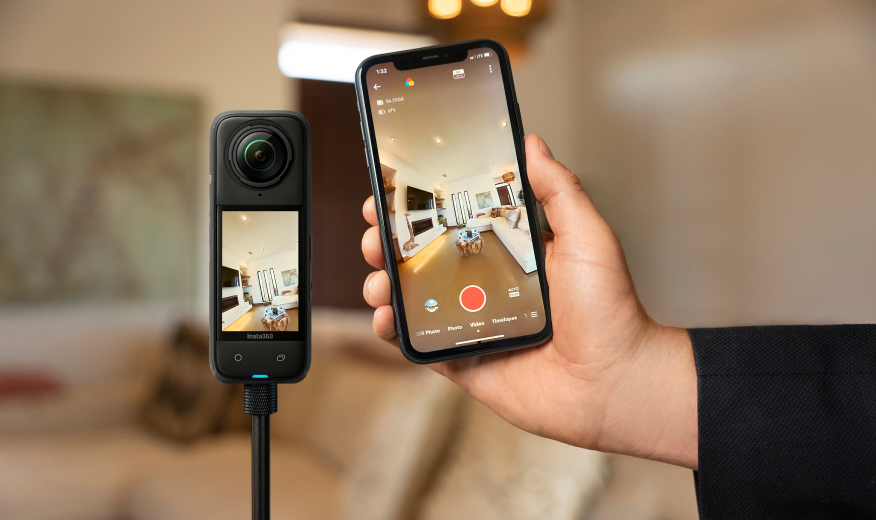
Capture. Antigravity A1 captures 8K 360-degree footage from the air. Insta360 X5 does the same from the ground. Both devices produce panoramic video that records a scene from every angle in a single pass. No stitching, no separate shots, no ground control points.
Process. The footage is uploaded to Splatica, a cloud-based 3D reconstruction platform built on 3D Gaussian Splatting (3DGS). Splatica analyzes the spatial data embedded in the panoramic video and reconstructs it as a navigable 3D environment. The processing runs automatically, and the output is a browser-ready digital twin.
Share. The result is a link. Anyone can open it on any device and explore the space as if they were standing inside it. No app installation, no VR headset, no specialized viewer.
For the UGC Challenge, Splatica provided the first 1,000 users with free reconstruction credits. The only requirement was to capture a scene that mattered to them. The pipeline handled the rest.
What Creators Discovered When They Tried It
The feedback from participants revealed consistent patterns.
Impressive 360-to-3D performance. Many first-time 3DGS users were amazed by the results generated from 360 cameras and drones. The leap from "I shot a video" to "I have a 3D model" felt immediate, not incremental. Users specifically praised the image quality, clarity, and natural color reproduction of the captured footage. The high resolution and sharpness met professional-grade expectations straight out of the camera.
3DGS as a new documentation format. Participants recognized that a 3DGS model is something fundamentally different from a photo or video. It allows someone to enter and explore a digital space anytime, not just view a recording of it. That distinction turned out to be intuitive even for creators who had never encountered the term "Gaussian Splatting" before.
Cultural heritage value and the "time capsule" concept. Users strongly connected with using 360 and 3DGS to preserve historical sites. They saw the campaign's time capsule framing as a meaningful way to record, share, and pass on cultural heritage. Some participants shot world-famous landmarks. Others shot the streets and buildings from their own childhood. The motivation was the same: this place matters, and I want to keep it.
Hardware that earned trust. Beyond the 3D models themselves, participants consistently praised the capture hardware — Antigravity A1 — on four fronts: image quality (sharp, natural color, meeting professional needs), stabilization (the standout feature -- smooth footage even in windy conditions), portability (lightweight, foldable, easy to carry for travel and outdoor shoots), and ease of flight (stable, intuitive controls that beginners could pick up quickly).
Voices from the Industry
The campaign drew participation from across the professional spectrum. Three contributors stood out for their depth of technical analysis and reach.
Corridor Crew — Niche to Mainstream
The U.S. VFX powerhouse produced a YouTube video titled "THIS is the Biggest Thing Since CGI." In it, they walked through why phone-based and camera-based scanning workflows are painfully slow and why Antigravity A1 is different, calling the drone "a game changer in the imaging industry." The video reached 2.6 million views and 120,000 likes within three months, generating a comments section full of people discovering 3DGS for the first time.
The impact of this single video went beyond views. It effectively introduced 3D Gaussian Splatting from academic and niche tech circles to the mainstream imaging and creative industry. The video provided a concrete path to getting started with 3DGS, translating what had been largely research and open-source territory into an actionable workflow. The central message resonated: a 360 camera is the better way to produce hole-free 3DGS captures.
Michael Rubloff — Professional Perspective
Tech expert Michael Rubloff shared his end-to-end experience with the A1 on LinkedIn, covering capture workflow, reconstruction analysis, and final model outputs. His perspective carried weight because it came from a professional who tested the pipeline under real conditions.
"I'm not a drone person by background, but the FPV-style goggles and controller made the learning curve far shorter than I expected," he noted. "Flying in cinematic mode, the slowest of the three modes, gave me the sharp, parallax-rich frames that Gaussian Splatting thrives on. Because every flight captures a full 360 sphere, roughly 10 minutes in the air was enough to cover a scene completely."
Gabriele Romagnoli — Testing Across Pipelines
Creator Gabriele Romagnoli tested Antigravity A1 across three different Gaussian Splatting pipelines, documenting his flight experience and explaining how he simplified the resulting splat for VR viewing. His work demonstrated that the A1's output is not tied to a single platform — the same capture can be processed through multiple pipelines depending on the creator's goals.
The World Showed Up
The UGC Challenge ran for 72 days and drew 2,000+ creators from 20+ countries, producing 225+ submissions. The shortlist spanned every continent and every type of built and natural environment. Here are some memorable examples.
Borobudur Temple, Indonesia
Creators @nabilensart and @arisazumi captured the world's largest Buddhist temple, a UNESCO World Heritage Site. The complex, tiered structure, complete with intricate relief panels and stupas, demonstrated that the workflow scales to massive heritage sites.
Kurotani Konkaikomyoji Temple, Kyoto, Japan
Creator @takashi.film used Antigravity A1 to capture 8K panoramic footage of this historic Buddhist temple. The result was a browser-navigable spatial experience, accessible on any device without specialized apps.
Chichen Itza, Mexico
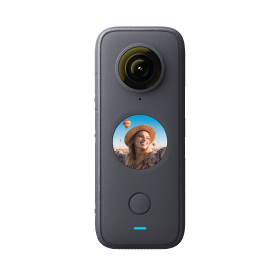
One operator, one Insta360 One RS, one afternoon. The result was a clean, explorable 3D model of El Castillo, one of the New Seven Wonders of the World. No crew, no specialized rigs.
Chengyang Bazhai, Guangxi, China
A traditional Dong ethnic village, shot with the X5 for ground-level detail and the A1 for aerial coverage. Processed via Manycore Aholo, the result transformed the village into a gamified interactive experience where users can explore hidden architectural and cultural elements.
Sulphur Springs Water Tower, USA
A landmark of the historic Sulphur Springs neighborhood in Tampa, Florida. Captured on the A1, a simple 5-minute drone flight was enough to generate a stunning 3D model of the tower and its surrounding landscape.
Strombolicchio Lighthouse, Italy
A sea stack and lighthouse off the coast of Stromboli, one of the Aeolian Islands. Captured on both the A1 and X5, a short flight and ground pass around the base produced a detailed 3D reconstruction of this dramatic volcanic rock formation.
Nivolet Cross, France
A mountain cross perched at 2,612 meters in the French Alps. Captured on the A1, a single 5-minute drone flight circling the cross was sufficient to generate a complete, explorable 3D model against the alpine backdrop.
Hariphunchai Temple, Thailand
Hariphunchai Temple is one of the most important and sacred temples in northern Thailand, and the Insta360 X5 beautifully captures its rich colors and refined decorative details.
Suvilahti DIY, Finland
From within to high above it, Antigravity A1 captures Suvilahti DIY in full, preserving the colorful street art with remarkable clarity. This famous skatepark, built by the skaters themselves in Helsinki, Finland, is one of the city's important local landmarks.
What Splatica Learned from 225 Submissions
We spoke with Splatica about what stood out from the campaign. Their answers reveal a view of spatial content that goes beyond the technology itself.
The Audience Was Broader Than Expected
"Before the campaign, we expected to reach people who were already interested in 3D reconstruction," Splatica told us. "Instead, we reached a much broader creative community. Photographers, filmmakers, drone operators, travelers, architects, and many people who had never worked with 3D joined the initiative from across Asia, Europe, North America, and South America."
"That was probably our biggest takeaway. Spatial content is no longer interesting only to technical users. It's becoming a new creative medium, and more creators are ready to experiment with it than we expected."
Splatica added that technologies become mainstream when creators begin using them to express ideas, rather than simply demonstrating the technology itself.
Diversity of Input Was the Real Prize
"The biggest value wasn't simply the number of participants. It was the diversity of ideas," Splatica explained. "Creators captured an incredibly wide range of places for reconstruction, from historical landmarks and forests to beaches, abandoned buildings, mountain trails, and remote villages."
The campaign became the most comprehensive real-world validation of Splatica's reconstruction pipeline to date. "Different lighting conditions, environments, movement styles, and capture techniques revealed both the strengths of the technology and the areas where we can continue improving. When hundreds of creators approach the same technology from completely different perspectives, you quickly learn where the technology feels natural and where it still needs to improve. That's the kind of feedback you simply can't generate inside a company."
Capture Technique Matters More Than Equipment
"The quality of a reconstruction depends far more on how a scene is captured than on what happens afterward," Splatica noted. The strongest results came from creators who followed the capture guide, moved smoothly, and captured subjects from multiple viewpoints. "That's encouraging because it shows that great results don't necessarily require more expensive equipment. They mostly come from understanding how to capture a scene well."
Creators Treated 3DGS as a Storytelling Medium
Before the campaign, Splatica expected to evaluate technical reconstructions. Instead, they found creators using 3DGS as a storytelling medium. "The best entries weren't just technically impressive. They were well composed, with camera movement that naturally guided viewers through the scene and made exploration feel intentional rather than accidental."
The shortlist featured forests, waterfalls, villages, temples, industrial sites, sculptures, beaches, mountain roads, and many places that rarely appear in digital archives. "Creators often find beauty in places that others overlook."
The Verdict
The project was judged by a panel of five experts spanning heritage preservation, 3D reconstruction, academia, and industry: John Ristevski (CEO, CyArk), Andrey Shelomentsev (Co-Founder, Splatica), Thomas Flynn (Digital Heritage Specialist), Prof. Mattia Previtali (Politecnico di Milano), and Michael Shabun (CEO, Antigravity). Entries were evaluated on creativity, modeling quality, interpretation of theme, social media impact, and product utilization.
The first prize went to @Dung3onlord (Reddit) for De Haar Castle, the largest castle in the Netherlands. Check out the full list of winners here:
Where Spatial Content Is Headed
Project ETERNAL was never about capturing heritage sites in 3D as an end in itself. It was about proving that the tools for spatial content creation are no longer locked inside institutions. A 360 camera, a cloud-based 3DGS pipeline, and a person who cares about a place -- that is the formula. The campaign showed it works at the scale of a UNESCO World Heritage site, and it works at the scale of a neighborhood water tower.
Splatica put it best: "Every new visual medium follows a similar path. At first, people are fascinated by the technology itself. Eventually, they stop talking about the technology and start talking about what they can create with it. We believe 3DGS is reaching that stage."
Processing times are decreasing. Reconstruction quality is improving. Accessible hardware is already here. The next chapter starts with whoever picks up a camera.
Project ETERNAL was launched by Antigravity and Insta360 in partnership with CyArk, the global cultural heritage preservation NGO. The UGC Challenge was supported by Splatica as the 3D reconstruction partner. The campaign ran from April to July 2026.
Keen to keep up to date on Insta360 stories? Keep an eye on our blog and sign up for our mailing list. You can also contact our Enterprise team directly to see how 360 cameras can benefit your business.




%20(1).svg)


%20(1).svg)

.svg)